
ADP, Private Sector Growth, and Data Storytelling. Also Known As: The February 2026 Jobs Numbers

By Jillian O'Malior, Founder & CEO, New World Labs
PUBLISHED: March 5, 2026
This week, ADP released job numbers for February, stating that 63,000 jobs were added to the private sector specifically.
And the thought leaders of LinkedIn are viewing this as evidence of a resilient and growing market, especially given the upswing from the January jobs numbers of 11,000.
First off, everyone calm the f*ck down.
This is just a number until we look at the context, m’kay?
And the context is telling us that this isn't the magic number we've been hoping for. So with that said, here are a few important details to look at before we start praising growth:
The January number was adjusted, from 22,000 to 11,000. That’s a pretty drastic adjustment, which could indicate that this February number may not be all it’s cracked up to be either. We’ll only really know once the next report comes out. But, for now, this is the number we have.
Of that 63,000 jobs, 58,000 were in the Education & Healthcare Services sector. A sector that is heavily made up of training and certification-specific labor. Now, this is a hopeful number for our communities at large (healthcare and education is needed), but this is not really a good indication of what’s happening for the large swaths of unemployed folks OR the economy right now.
For that, this number is more telling: 30,000 jobs LOST in the Professional & Business Services sector. That’s your white collar work, your tech, your accounting, your marketing, your business operations and HR. What this is telling us is that the growth we’re seeing is highly concentrated to only two sectors (Construction also saw growth of 19,000).
With these factors in mind, what we can also see is that if you remove those two sectors, you actually see a contraction in growth of 14,000 jobs. Negative job growth across the other 8 sectors.
Now, what everyone is heralding is the seeming growth from January to February. But what we really need is an apples-to-apples view: all the February private-sector jobs. And what does that tell us? Even with this “upswing” from January, this is the lowest number of jobs added in February in the last 10 years.

Source: ADP
I'm not saying that this isn't positive; I'm saying we have every reason to be wary of anything that's being pushed quickly as signs of recovery when we don't have a full picture in place. Long-term thinking wins the race here, friends.
Because I believe this tells a far more important story. One that is showing a massive shift in the way we operate as a society. And one that could foretell real, long-term problems if it's not addressed head on.
Let's go back to those two large growth sectors: Education & Healthcare Services and Construction.
In February 2026, with the numbers we have available, these two sectors accounted for 77,000 jobs added. Once you factor in the other eight sectors, that comes to 122% of all private-sector job creation and growth the past month.
But for a job market to be healthy, growth should mirror the workforce distribution, don't you think? So then when you see two sectors accounting for 122% of job growth, what you're actually seeing is a massive concentration of hiring and expansion. A concentration that could be crippling if it continues.
Because to look at growth, we need to also look at the percentage of the workforce that aligns with that growth.
Looking at the available BLS data, Education & Healthcare Services and Construction account for about 30.8 million of workers, or roughly 23% of the employed population in the U.S.
That leaves the other eight sectors (Professional & Business Services, Manufacturing, Information, Trade/Transportation/Utilities, Natural Resources & Mining, Financial Activities, Leisure & Hospitality, and Other Services) to employ approximately 100 million workers, or roughly 77% of the employed population.
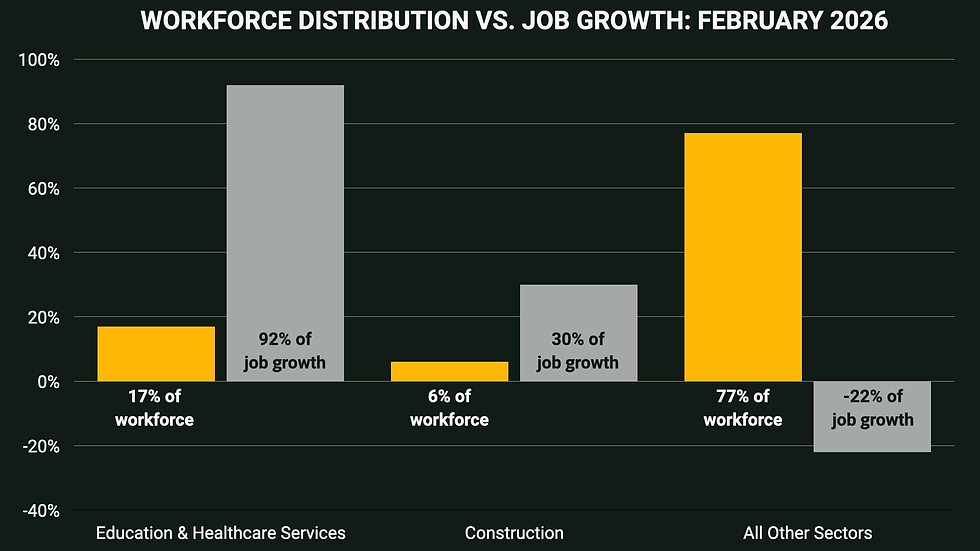
Sources: ADP and BLS
23% of the workforce saw a share of job growth of 122%.
77% of the workforce saw a share of job growth of -22%.
Education & Healthcare Services and Construction are not just leading growth, they're subsidizing the very real losses we're seeing in the majority of the private sector. We have a contracting majority, and that will lead to systemic issues if it's not either corrected or properly supported.
Because data storytelling is also cultural storytelling. And that's where the individuals come into play.
One of the great tenants of the American Dream is private business. The idea that a person can take an idea, an education, a skill. And with some hard work, grit, and a work ethic, can turn those elements into a life worth living, a life worthy of pride and honor. The ability to thrive with respect.
And if these numbers are accurate, what we're seeing is that at least for the month of February 2026, the growth, and therefore the security, of the American Dream has ceased for 3 out of 4 working Americans.
This is not a factor of "just pivot to healthcare and construction." These are highly skilled, highly trained professionals. Decades into their careers. Being met mid-life with erasure and a lack of options. These are also young adults, coming out of college, being told that their last 4-6 years were all for naught, because virtually the entirety of entry-level white collar work has been seemingly wiped out overnight. Entire segments of our workforce are disappearing, with no real plan of how to take care of the individuals navigating a shaky and fragile system. A system seemingly being propped up by two sectors and 23% of the population.
Time will tell if this trend continues. Because again: this is a snapshot. A single month being reported only a week out from it's end. But for the job seekers and recruiters who are on the frontlines of this job market, this feels like the canary in the coal mine we've been screaming about. Historically speaking, a significant drop in the Professional & Business Services sector is the first move before a much wider economic recession. And 30,000 jobs loss the second month of 2026 should give us all pause.
Time will tell.
But don't let the story of prosperous growth mask the context of the subplot.
Data & Methodology:
Primary Source: ADP National Employment Report (Private Sector Payrolls), released March 4, 2026 (Source).
Revisions: January 2026 figures revised from 22k to 11k per ADP Research Institute (Source).
Workforce Distribution: Based on U.S. Bureau of Labor Statistics (BLS) Current Employment Statistics (CES) establishment data for 2025/2026, mapping ADP sectors to total private-sector payroll proportions (Source).
Scope: All figures refer strictly to the U.S. Private Sector; public sector (government) and self-employed data are excluded to maintain a clean comparison of business growth.

Comments