
FDR, Trump, and the Golden Age of America. Also Known As: Where the F*ck Is Our New Deal?

Updated: May 25
By Jillian O'Malior, Founder & CEO, New World Labs
PUBLISHED: January 6, 2026
I’d like to, if I may, take you on a strange (and nostalgic) journey.
The year is 1955. The horrors of the Great Depression and rationing of WWII are far in the rear view mirror of life. America is in an economic and cultural boom under the stable stewardship of Eisenhower.
You come home from your union-protected job to your pretty little tract home, picket-fence and all. Your wife, two children, and that rambunctious little mutt Skipper wait for you inside. The rooms are clean and well-appointed, the casserole is baking away, and you settle in for your evening in ease, knowing that stability, prosperity, and life you can take pride is yours for the taking. You’re not wealthy by any stretch of the imagination; but you have 1100 square feet, a working car, and even a brand-new Admiral television to watch The Ed Sullivan Show on every Sunday night.
You are a self-made man, after all. You grabbed those bootstraps and pulled yourself and your family up with them, by gum! Yes, that pretty little tract house was subsidized by the GI Bill, but you earned that fighting for your country. Utilities are low, but everyone’s are in this area, that’s what the Rural Electrification guaranteed you. And while you only have a high school diploma, no fancy college degree, that $4,400 a year takes good care of all of you. Thankfully the Wagner Act forces the boss man to share in the profits with you and your fellow workers. But it’s still your hard work that keeps you gainfully employed, and ensured a pension when the time comes. Bootstraps.
Let’s fast forward a bit. 70 years to be exact.
It’s 2025. Enough time has past since Covid that we refer to it as “back when,” but the anxiety and social changes of the pandemic still linger. And now, instead of Eisenhower’s steady, guiding hand, we are firmly in the second term of Trump.
You come home from your hybrid data analyst role to your 2,400 square foot model home, built right before the bubble in 2005. The construction was quick, and a bit shoddy, so you feel like there are always repairs to be made. Your wife isn’t home; her 12-hour shift at the hospital started 2 hours ago. The kids are at their travel ball and dance comp practices; about $16,000 a year collectively. But, kids have to be involved in an activity nowadays, especially if you want to keep them off the screens, and recreational leagues don’t really exist anymore past the age of five. You have high-speed Internet, four iPhones for the family, two EVs for you and your wife for efficiency and environmental care.
And you’re drowning. Your company went through four rounds of layoffs in 18 months, and you fear you’re on the chopping block next, especially since an acquisition of an AI startup just went through. You and your wife’s combined income barely stretches to cover the bills month to month; neither of you has seen even a cost of living increase in almost four years. Groceries are high, gas is high, tariffs have slashed your purchasing power so drastically you’re terrified to make any major purchase. Your student loan debt between both of you is six figures. You’ve dipped into the 401k twice now; once when the barely 15 year-old pipe burst in the upstairs bathroom, and another time when that “routine” procedure had to be done by an out-of-network doctor and insurance refused to cover it.
You feel like anxiety and instability rules your life. Your older family members keep talking about “the good old days,” and how they made so much less money than you did, and on only ONE income! They made it work; so why do you seem to be struggling so much? All those luxuries and fancy technology devices, most likely. Besides; the immigrants are the real problem, taking good American jobs and messing with our economy. You question it yourself: on paper, your combined income is leaps and bounds beyond the $4,400 a year in 1955. But you feel vulnerable to collapse every single day.
Welcome to the American Dream(TM)
We’ve all heard it, it does us no service to ignore it: the goal is to Make America Great Again. And while there is some existential debate about when the “Again” really references (though a lot of us have our suspicions about just how far back they’d like us to socially regress), we do hear the Golden Age of the 1950s referenced ad nauseam. Post-WWII, pre-Vietnam. When the U.S. economy truly hit its stride with a glorious combination of high consumer confidence, massive industrial output, and the peak of the American middle class. The middle of the decade saw record GDP growth, the auto boom, the housing construction boom, hell, the baby boom. Marginal tax rates topped out at 91%, which means the smartest moves for leaders to do was reinvest into the company rather than their own pockets: infrastructure, workers, long-term growth and stability. Combine that with roughly one-third of the workforce being unionized, we can see a direct correlation between the massive productivity of industry and the success of the middle class.(1)
But here’s the rub: when we hear this trad-life, 1950s ideal being referenced (when men were men, women were relegated to the kitchen, and children were seen but not heard) there is a key element missing from the discussion. Because yes, that Norman Rockwell-esque aesthetic feels inherently traditional and socially conservative. But the reason it even came into existence in the first place is because of the nearly two decades of aggressive, socialist-adjacent state-building that preceded it.
But what does that have to do with 2025?
We are currently being sold a 1950s social agenda while the remnants of the 1930s foundations that built it in the first place are being systematically demolished by Project 2025.
FDR and The New Deal
March 4, 1933. Capitol Plaza, Washington D.C.(2)
A country in the deepest grips of the Great Depression. And 100,000 citizens stood there and listened to their newly inaugurated president delivered those iconic words:
“The only thing we have to fear is fear itself.”
He spoke of authority, of stewardship. He promised that he would act with immediacy to face the “dark realities of the moment.” He spoke of “wag(ing) a war against the emergency” as if we were “invaded by a foreign foe.” He was bold, he was assertive, and he locked in his country’s belief that they had elected the right man for the job.
And he moved with a vengeance. The next day, he declared a four-day bank holiday to halt the flowing cash withdrawals that were crippling the financial industry. Five days later, the Emergency Banking Act was put into place, and Americans were encouraged to pull their savings out of the mattresses and put them back into the banks. By the end of March, nearly three-quarters of the at-risk banks reopened.
This stemmed the bleeding. But he was just starting.
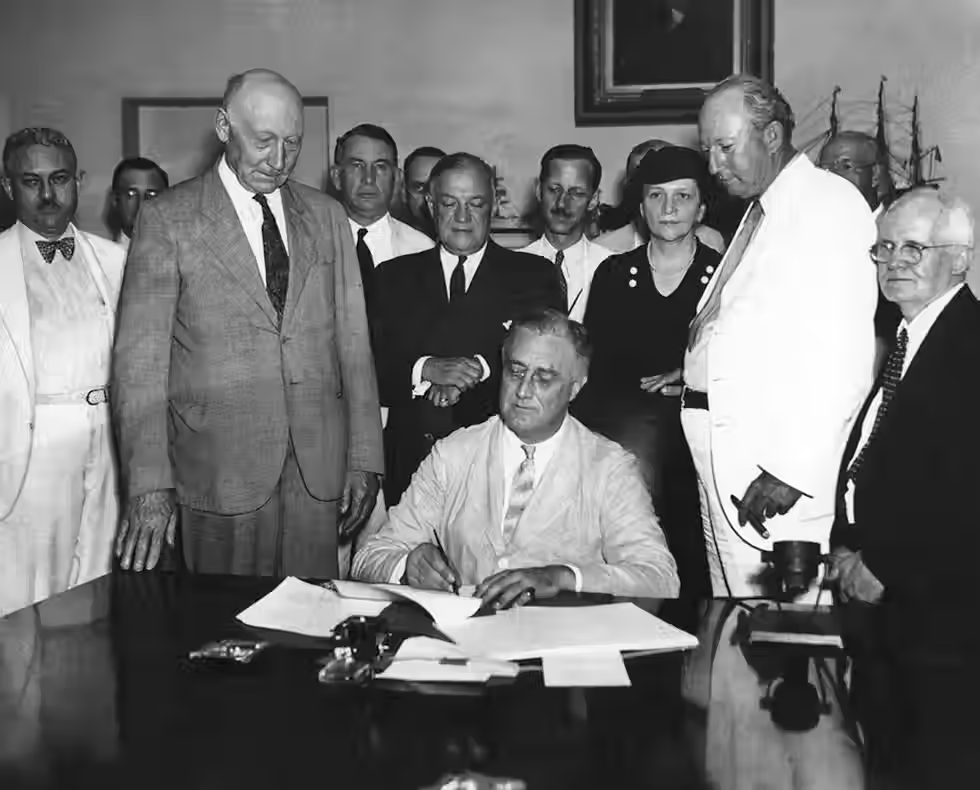
FDR’s first 100 days were focused on aggressively getting his country out of the Depression as best he could. He worked with Congress to end Prohibition, signed into law the Tennessee Valley Authority Act to build dams that both controlled flooding and produced inexpensive power to rural areas. Congress passed a bill to pay commodity farmers in order to address surplus and right-side prices. The National Industrial Recovery Act set union power up for success; guaranteeing the right to unionize for higher wages and improved working conditions. The Public Works Administration, the Glass-Stegall Act, the Home Owners Loan Act.
100 days. Some of it controversial, yes, but all of it pushed, enacted, and signed into law in order to protect the people he served, and the country he presided over.
Fast forward to 1935.
Unemployment still high, the economy still unstable, and the Dust Bowl destroying farmer’s livelihoods. And FDR acted swiftly.
The Wagner Act officially legalized unions and collective bargaining, and the National Labor Relations Board was formed to supervise elections and prevent unfair treatment. With income stability and improved working conditions, this means the true beginning of the growth of the middle class.
The Works Progress Administration was developed to directly address unemployment. Millions of out of work Americans were hired to perform local infrastructure improvements, giving them immediate financial relief while improving their communities at the same time, anything in the public space. I mean, fuck! He even focused on cultural programs for improvement, directly putting government money into the pockets of artists, writers, and creatives (this one in particular feels almost like a fever dream).
Next came the Social Security Act: guaranteed pensions, unemployment insurance, and protections of dependent children, the disabled, and the elderly. He insists that we are responsible for one another, particularly the most vulnerable of our population.
“The forces of organized money are unanimous in their hate for me; I welcome their hatred.”
FDR spoke out against the “Economic Royalty;” the business leaders who not only personally profited from the Great Depression, but then sought to leverage that wealth to assume governmental control (I know; this is sounding familiar). He derided them for opposing the New Deal, seeking only to protect their concentrated wealth and power at the cost of public welfare. The enemy of the common man, the ones who maintained that “economic slavery” need not interfere with the ideals of American freedom. They resisted government regulation and intervention during the Depression, under the guise of Constitutional empowerment, and saw FDR’s aggressive protections as an over-functioning of federal power.
But he persisted. He fought the courts; threatening to pack them with progressives in order to neutralize the obstructionist conservatives fighting back against his policies.
By 1937, 8 million American workers had joined unions and fought for their rights.
By 1941, the U.S. was firmly engaged in WWII, the economy had been stimulated through this, and the Great Depression had officially come to an end. The country had been protected, workers’ rights had been enacted, and interventionist government was widely considered amongst the growing middle class to be good for families, the economy, and the nation.
And we were primed, socially and economically, for that Golden Age of the American Dream.(3)
The Bizarro “New Deal”
Like we said: our goal is to Get Great Again. So; how does the 2025 timeline compare?
Trump’s first 100 days back in office were just as active as FDR’s. On day one, a record 41 Executive Orders were issued, covering everything from revoking orders under the previous administration, federal hiring freezes, withdrawing from the Paris Climate Agreement, withdrawing from the World Health Organization, even a restoration of capital punishment. He established DOGE (Department of Government Efficiency), which began immediately firing tens of thousands of federal workers and hollowing out federal agencies like the CDC and HHS.
By July, Trump had enacted one of the greatest wealth pivots in American history; the “Big Beautiful Bill Act” made the 2017 tax cuts permanent and lowered the corporate rate to 18%.(4) By this point, tech layoffs had reached roughly 80,000 for the year, and with an ever-slowing job market and hiring freezes across industries as AI’s swift domination continued, American workers are feeling the squeeze.
September saw not even the vulnerable can escape being “Made Great Again.” New SNAP work requirements kicked over 680,000 people off benefits overnight. But, the administration knows where America’s priorities really lie; they focused their attentions on ensuring that “gender equality” and “reproductive health” were removed from all federal documents.
And meanwhile, ICE focused their attention on the “true” threat, detaining over 68,000 people over the course of the year, with federal funding running through the program in order to stand up more agents, more detention centers, and more supports.
The contrast couldn’t be clearer: while FDR’s first 100 days and subsequent years were dedicated to building, in 2025, we’re seeing a rather dark inversion: a dedication to tearing down supports, and a transfer of wealth from the ever-shrinking middle class upwards.
Because while FDR reminded us that “the only thing we have to fear is fear itself,” our current administration has weaponized fear (of immigrants, of trans people, of the “deep state”) as a primary tool to pass economic policies (like the 10-41% universal tariffs from April 2025)(5) that cripple the very people that brought them into office.
But Jillian, We’re Not In A Depression?
Yes, I know that reader. But we are absolutely in a repeat of the pre-Depression era.
Welcome to the new 20s.
Let’s look back just a mere 98 years. In 1928, the top 1% of Americans earned roughly 23.9% of all income.(6) Read that again. Almost one-quarter of all national wealth was being hoarded by 1% of the population. To understand just why this is so precarious, we need to look at a mathematical measure known as “The Gini Coefficient.”
For those of us whose eyes cross the second numbers come up, this is the nuts and bolts of it: the Gini Coefficient measures inequality and income distribution. In this measurement, 0 represents perfect equality, and 1 represents perfect inequality. In 1928, this measurement had climbed to nearly .5.
What does this mean? Well, it means that the middle class in 1928 had virtually no purchasing power. Instead, they relied on credit (again, SOUND FAMILIAR????) to purchase the very goods they were responsible for producing. And this gap grew until 1929. And what happened in 1929, class? The credit bubble burst. The stock market crashed. The economy collapsed. And the wobbly structure everything was propped up on revealed the truth; virtually no “real” money was circulating below that 1% line.
Let’s come back to today now.
As of late 2024, the top 1% nationally in the U.S. has climbed back up to over 22% of the hoarded wealth; virtually identical to our pre-Crash ratio.(7) In some states, like Florida and New York, that gap is actually worse than it was in 1928.(8) Our Gini Coefficient is currently being measured at around .46.(9)
Just shy of 100 years later, we’ve learned nothing. And we are repeating the mistakes of our past.
Why This is EXTRA Problematic
While FDR entered office four years post-Crash, he knew the only way to right the ship was to get the money redistributed, and fast. This wasn’t a mere “tax the rich” scheme; this was an engineered, decade-long event that has become known as “The Great Compression.” Effectively, he utilized the tax code to drain stagnant wealth out of the hoarding 1%, forcing it out of the vaults and back into the bloodstream of the national economy. By hiking the top marginal tax rate to 91% (even as high as 94% during WWII), he created an environment where it was less beneficial (and more expensive) to be a billionaire, and more beneficial (and cheaper) to be a builder.(10) Now, the effective rate (what they actually paid) after deductions and clever accounting was closer to 42%. But compare that to 2025’s 26% effective rate, and that 16% gap is doing a helluva lot of work for the people.(11)
This play of the tax code saw the Gini Coefficient plummet into the high .3s, which effectively created the middle class of the 1950s that we all idolize to this day. Because by ensuring that the COUNTRY got richer, that meant the workers themselves got richer, not just the stockholders.
But this is the Bizarro 20s. So let’s look at just what’s happening now.
First, we’ve spent the past 40 years undoing FDR’s work; what economists call the Great Divergence. Many of the middle class financial protections that were put in place have been dismantled and swept away.(12)
But with a wealth distribution and Gini Coefficient just on the coattails of 1928, we’re seeing our government enact laws that are potentially disastrous. Because while FDR used the Revenue Act of 1935 to soak the rich, the Big Beautiful Bill does the opposite. It made the 2017 corporate tax cuts permanent, it cut the estate tax (allowing the New Royalists to pass down multi-generational tech wealth untaxed), and it slashed SNAP and Medicaid by $1.1 trillion to offset these cuts for the 1%. Effectively, we have made the hoarding of wealth not only easier, but subsidized by the vulnerable populations that FDR insisted we protect.
During the New Deal, productivity gains were tied to wage gains through the National War Labor Board. In 2025, productivity is being automated, but the gains are being purely captured at the top 1%. Less work, less wages, more wealth disparity. A crash is imminent.
Basic Economics, As Explained By An Arts Major
Because our man FDR understood that an economy is like a forest. If resources are distributed so that only the tallest trees get watered, the brush at the bottom dries out. And eventually, the whole thing catches fire and devastates the entire eco system (the tall trees included). He created a system so that coverage, resources, and water could reach every part of the forest to ensure it thrived and was never consumed by fire.
In 2025, we are actively diverting water away from the entire root system. The tallest trees aren’t just being watered more; they’re draining water from the very forest floor that props them up. And by making the tax cuts of H.R. 1 permanent while what remains of the middle class faces 20% tariff inflation, we are recreating the exact dry brush conditions of 1928, and then lighting a match.
Because we may be hearing a lot of pride in this 4.3% GDP growth rate, proof of our growing greatness. But we’re also seeing 63% of all consumer spending coming from just the top 20% of households. We’re seeing job growth stagnation; only an average of 51,000 per month in Q3. And this is precarious in a very direct way.
Economies work because money is meant to be fluid, constantly flowing from one hand to another. Think of the concept of stimulus: if a middle class family suddenly finds themselves $1,000 richer, what do they do with that? They buy groceries, they repair their car. Maybe they take a trip, maybe they put a small portion away in savings for a rainy day. But that money is spent; it’s redistributed through the economy, changing hands 5-6 times, creating velocity. Now look at the top 20%. If they find themselves suddenly $1,000 richer, what do they do? Why, they park it; in a high-yield savings or offshore account. They don’t need it to survive and thrive, so it’s hoarded, added to their stockpile. It never circulates, it never stimulates. It just stops moving entirely.
So then as the middle class gets squeezed, when they find their cash flow trickling down to a drip, they stop spending. It’s not that they hoard; it’s that there’s just nothing there to circulate. They rely on credit to make the necessary purchases, and save what few pennies they get just in case. That’s when we see the concentration of consumption move up the funnel. And THIS becomes dangerous because now, the economy is ultimately reliant on the spending whims of the wealthy few, and we gain a single point of failure engine. Our entire economy operates on vibes, not on necessity. When the middle class has purchasing power like they did in the 1950s, even if the top 20% restrict, the majority of the population is still there, keeping stores and factories and production open. Because when spending is widely discretionary (trips, luxury goods) that can get turned off overnight. When spending is widely essential (groceries, transportation, homes), it’s incredibly sticky and stabilizes the economy. But in our current economy, if the stock market dips or that ridiculous AI bubble wobbles slightly, the 20% pulls back to protect their wealth, and all that discretionary spending grinds to a halt, with no essential spending to keep the machine going.
And then what happens is what is referred to as a “Luxury Trap.” A market that builds only for the elite, because those are the only ones with any purchasing power. Instead of the row of pretty tract starter homes, all we get is luxury condos at $2.1 million a pop. Instead of diners and pubs opening their doors, we get high-end bistros and microbreweries that charge $30 for a burger. And the real economy, the one that provides respite and stable jobs for the rest of us, is left to wither on the vine. And when the spending base is this narrow, when the top 20% are the only ones with disposable income, and there is no middle class to pick up the economic slack, the slightest breeze sends everything toppling over and disaster strikes.
And that’s exactly where we are.
Well Thanks, This Was Depressing
I know. I know. So let’s just bring it home and see what change we can elicit.
The numbers don’t lie, even if the rhetoric and propaganda does. We cannot build a 1950s middle class boom using the 1920s economic blueprint. We cannot dismantle the floor board by board while raising the ceiling higher and higher and claim that this is what brings us back to the Golden Age, that this is what “Makes Us Great Again.” And we cannot continue to allow the New Economic Royalists to seize control in order to make their stockpiles even higher, despite our administration being rampant with the very elitists that want to squeeze you for every penny you’re worth and then some.
Project 2025 is well underway, claiming to get us back to the glory of a bygone time. But it is only interested in the aesthetic, not the function. It wants us back to single-income households while stripping away the very socialized protections that made that possible. Wants us to undo all the social progress we’ve made to care for our marginalized and vulnerable populations so that the whole of America will sparkle with whiteness. It wants “true-blooded Americans” back in the fields moving our agriculture industry forward, with no recognition for the fact that the poverty-level wages propping that industry up are untenable. They want us married off and popping out children, with no reliable or affordable healthcare to be found. And they want us starving, exhausted, docile. Fighting with each other for the few meager scraps they’ll toss our way so that we’ll barely notice when even those scraps shrink.
We’re being sold the dream of the thriving 1950s while the breadlines of the 1930s are being built. With a wanton disregard for the fact that a democratic socialist agenda was the thing that got us there in the first place. A worship of the wealthy will never get the remaining 99% to prosperity; the whole of human history is littered with examples of exactly that.
We’re at a crossroads now. A point where we have to stop looking down and spitting on the folks just two inches below us and start looking up, up to the top of the canopy. We have to come together, in numbers magnified, and stop pretending like our individual successes aren’t dependent on the success of the whole. Stop believing the lie of “every man for himself” and start the chant of “every man for each other.” Rebuild that 1950s political coalition of the working class, the marginalized communities, the left-leaning intellectuals, the working women. The ones who knew that their bootstraps came at the hand of a government who believed that protecting and propping up the people first was the only way for all of us to truly prosper.
So, it begs the rather urgent question: where the fuck is our New Deal?
Sources
1 U.S. Bureau of Labor Statistics (BLS): Union Membership Trends in the 20th Century.
2 FDR Presidential Library & Museum: Digital Archives. 1933 Inaugural Address and 1936 “Rendezvous with Destiny” Speech.
3 The Living New Deal: Research and Mapping Project. University of California, Berkeley.
4 Congressional Budget Office (CBO): Cost Estimate for H.R. 1: The One Big Beautiful Bill Act (July 2025).
5 The Budget Lab at Yale: Economic Impact Analysis of the April 2025 Universal Tariffs.
6 Economic Policy Institute (EPI): The Unequal States of America.
7 World Inequality Database (WID): United States Wealth Concentration Report 2025.
8 Economic Policy Institute (EPI): The Unequal States of America.
9 World Bank Open Data: Gini Index, United States (Actual and Projected 2025).
10 The Tax Foundation: Historical Federal Individual Income Tax Rates & Brackets, 1913-2024.
11 Saez, Emmanuel and Zucman, Gabriel: The Triumph of Injustice: How the Rich Dodge Taxes and How to Make Them Pay.
12 The Roosevelt Institute: The Great Compression vs. The Great Divergence


Comments