
Mansions, Tenements, and Luddites. Also Known As: The New Industrial Revolution

Updated: Oct 13

Lemme take you somewhere nice first.
Newport, Rhode Island. 1895. The Breakers has just been finished for Cornelius Vanderbilt II: 70 rooms of imported marble, gilded plasterwork, and ocean views, built on a family railroad fortune that his grandfather, the Commodore, had grown to roughly $100 million by the time he died in 1877. The family lovingly refers to it as a “summer cottage.” They use it a few weeks each summer.
Now let’s go about 180 miles southwest.
The Lower East Side of Manhattan, same decade. A family of six in a two-room tenement apartment. The inner room has no window; law doesn’t require one. The toilet is a shared privy in the yard. The 10 year-old works, but plenty of 10 year-olds in 1890s America work. Five years earlier, a police reporter named Jacob Riis photographed rooms exactly like this one and published them in a book called How the Other Half Lives.(1)
Same country, same economy, same decade. Same railroad money moving through both addresses, but in very different directions.
So when the next tech bro on the keynote stage or founder on a podcast tells you AI is “the next Industrial Revolution,” I have only one question:
Which address do you think they’re talking about?
Everyone’s Favorite Scapegoat Analogy
You’ve heard it. I’ve heard it. We’ve all heard it about four hundred times this year alone.
“AI is the new Industrial Revolution.”
Jensen Huang has been announcing the next industrial revolution from his perch since 2024. Every hype post on LinkedIn or Twitter about the jobs AI is going to wipe out comes with the same performatively comforting footnote: Relax, this happened before. The looms replaced the weavers, the tractors replaced the farmhands, and look how it turned out! More jobs than ever, higher standard of living. Progress y’all!
To concede before I tear apart: they’re not TECHNICALLY wrong. All those things happened, all that progress was made.
They’re just conveniently skipping over, oh, about a hundred years.
Engagement baiting content creators love to do it. Because when people invoke the Industrial Revolution as proof that technological disruption just like “works out,” they’re focused on the ending. The mansions, the railroads, the rise of the middle class. Weekends. They’re pointing at the gilt and saying “see????”
What they’re not pointing at is the several generations of people who lived and died inside the disruption long before any of the payoff arrived. The people for whom it ultimately didn’t “work out” at all, because they were dead before it did.
The beginning of a revolution looks nothing like the end of it, my babies.
So let’s go back to the actual beginning; not the highlight reel.
The Weavers Go First
Britain, around 1800.
Handloom weaving was skilled, respectable work. A good weaver could earn 20-30 shillings a week, enough to support a family with dignity. Then, the power loom arrived. And the floor fell out. By 1809, weekly earnings were down to about 14 shillings. By 1817, less than 9. By 1832, the journalist William Cobbett described weavers who had formerly earned 20-30 shillings per week being “compelled to live upon 5s, 4s, or even less.”(2)
That’s effectively a 75% pay cut over one working lifetime. Not because the work got worse, but because a machine made their skill cheap. And the people who OWNED the machine kept the difference.
Some of them fought back. We all know them as the Luddites, and we’ve been taught to think of them as dumb, scared, anti-technology rubes smashing things they didn’t understand like brutes.
That’s the propagandized version. The real Luddites (1811-1816) were organized, skilled textile workers who understood the machines perfectly well. What they opposed was how the machines were being used: to cut wages, replace skilled workers with cheap unskilled ones, and push out quality work for volume. They were not anti-technology; they were anti- getting screwed by technology.
So how did the state respond exactly?
Did they negotiate? Retrain? Set a wage floor?
Well, in 1812, Parliament made machine-breaking a capital crime.(3) Break a stocking frame, get hanged.
Oh, but it gets better.
Under the Combination Acts of 1799 and 1800, it was already illegal for workers to organize at all. No unions, no collective bargaining. No “hey, so maybe we should all ask for a raise like, together.” In 1819, when roughly 60,000 people gathered peacefully at St. Peter’s Field in Manchester to demand parliamentary representation (because, another fun fact, most working people couldn’t vote), the cavalry charged the crowd with sabers drawn. At least 15 people died and hundreds were wounded. They called it Peterloo.(4)
So, to recap Phase One of the Industrial Revolution: your skills are worthless, your wages collapsed, you can’t organize, you can’t vote, and if you break the machine that did this to you, you die.
Progress!
The Real-Life Pinter Pause
Now here’s where it gets interesting, and where the “it all worked out” crowd starts looking anywhere but forward.
Economic historian Robert Allen studied British output and wages across this period, and he found something that has a proper name now: Engels’ Pause. Between 1780 and 1840, output per worker in Britain rose about 46%. Real wages rose about 12%.(5)
(fuck, that sounds familiar.)
For roughly sixty years (two full generations) the country got dramatically more productive, and almost none of it reached the people doing the producing. The wealth was real, it was measurable. It just went straight into the pockets of the people who owned the mills, the mines, and the machines.
Don’t want to take the economists’ word for it? Look at the bodies. Literally.
Average heights of British men fell for those born between roughly 1820s and 1850s.(6) During the greatest productivity boom in human history to that point, the people doing the work were getting physically smaller, because they weren’t eating enough.
In 1842, Edwin Chadwick published a report on sanitary conditions and found that in Manchester, the average age at death for laborers and their families was 17. For the gentry, it was 38.(7) (And yes, the laborers’ number is dragged down by how many of their children died. If you think that’s a clever rebuttal, Imma need you to sit with that for just a minute.)
But what did the law do about all this?
In 1833, Parliament passed the Factory Act, a genuinely landmark piece of legislation. It banned children under nine from working in textile mills, and limited kids aged nine to 13 to nine hours a day. To enforce it across the entire country, they appointed four inspectors. FOUR.(8)
In 1834, six farm laborers in the village of Tolpuddle formed a union to protest their wages being cut. They were convicted and sentenced to seven years’ transportation to Australia.(9) Meanwhile, the Chartists, a mass working-class movement asking for the radical concept of letting working men vote, petitioned Parliament three times, in 1839, 1842, and 1848. Millions of signatures. Rejected. Every. Time.(10)
This is the part of the Industrial Revolution that doesn’t make it into the podcast banter.
Meanwhile, in America: The Gilt
Okay, but that’s Britain. Surely the U.S. did better?
Mark Twain was actually the one who named the era. In 1873, he and Charles Dudley Warner published a satirical novel called The Gilded Age, and the title was meant to be an insult. Gilded, by definition, doesn’t mean golden. It means a thin layer of gold paint over something cheap and rotting underneath. Twain was telling you exactly what he thought of the era, and somehow we’ve spent 150 years using his insult as a compliment.
At the top: railroads, steel, oil, banking. The Vanderbilts, the Carnegies, the Rockefellers. When a reporter asked William Vanderbilt in 1882 whether his railroad was run for the public’s benefit, his reply went down in history: “The public be damned.”
At the bottom:
The 1900 census found that 18% of American children aged 10 to 15 were working. That’s roughly 1.75 million kids.(11) In coal country, boys as young as eight worked as “breaker boys,” hunched over chutes for ten hours a day, picking slate out of coal with bleeding fingers.
In 1886, workers in Chicago rallied for an eight-hour day. It ended with a bomb, police gunfire, and the Haymarket affair. In 1892, Carnegie’s Homestead steel works locked out its union, and a gun battle with 300 Pinkerton agents left ten people dead. In 1894, when Pullman railroad workers went on strike over wage cuts (while Pullman kept their rents in his company town exactly where they were), the federal government sent in troops. Roughly 30 people were killed.
And the courts? In 1905, the Supreme Court struck down a New York law limiting bakers to ten-hour days, on the grounds that it violated workers’ “freedom of contract.” (The freedom to work 16 hours in a basement bakery. Cool story bro.) In 1916, Congress finally passed a federal child labor law. In 1918, the Supreme Court struck that one down too.(12)
Then came March 25, 1911.
The Triangle Shirtwaist Factory, Greenwich Village. A fire broke out on the eighth floor. The workers, mostly young immigrant women and girls, ran for the exits and found some of the doors locked; managers locked them to prevent theft and unauthorized breaks. The fire escape collapsed. Fire department ladders only reached the sixth floor.
146 people died. Many of them jumped.
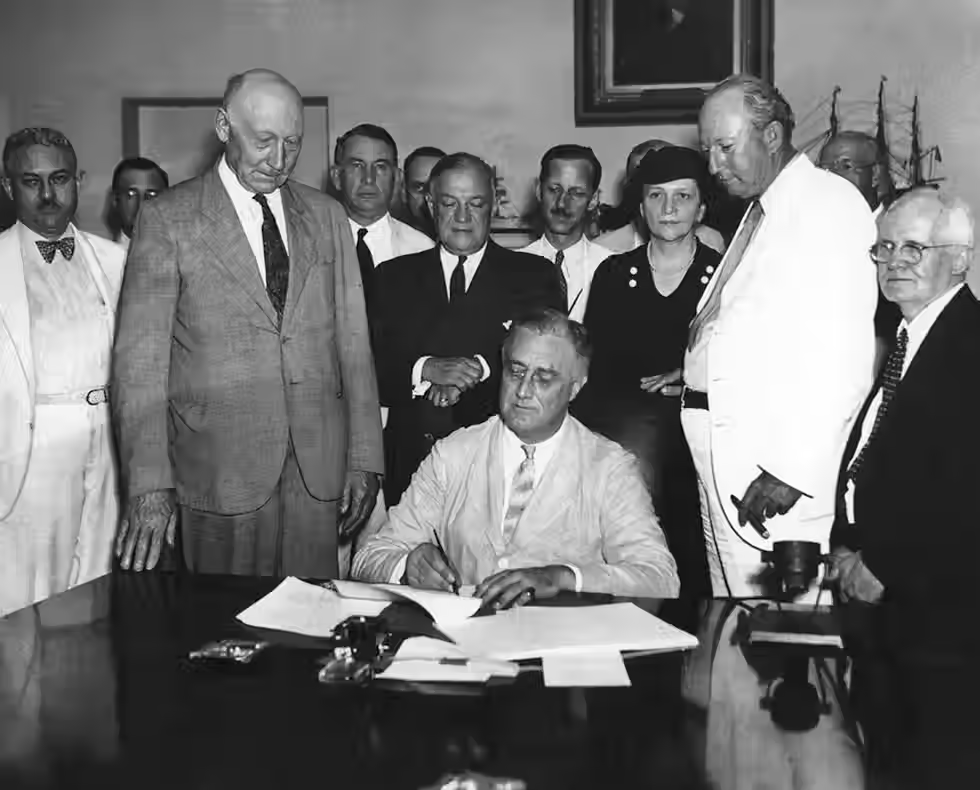
A 30 year-old labor advocate named Frances Perkins was having tea nearby, heard the engines, and ran to the scene. She watched them fall. She would later be quoted as saying the New Deal began that day.(13)
She wasn’t being poetic. Twenty-two years later, Perkins became FDR’s Secretary of Labor, the first woman to serve in a presidential cabinet, and the architect of Social Security, the minimum wage, and the Fair Labor Standards Act.
Every Protection You Have Was Paid For in Blood
So, this is what I’d really love y’all to pay attention to, because it’s the part the industrial nostalgia crowd tends to skip entirely.
The labor protections we treat as the natural, obvious baseline of a civilized economy were NOT gifts from benevolent industrialists who got rich and decided to share. They weren’t a byproduct of the technology, nobody’s steam engine came with a two-day weekend.
Every single one of them was dragged out of the dark period, usually over somebody’s dead body.
The eight-hour day traces back to Haymarket. The windows in your apartment trace back to the tenements; New York’s Tenement House Act of 1901 is the reason every room has to have one. Fire exits, sprinklers, and doors that open outward trace back to Triangle, which triggered a state investigating commission and dozens of new safety laws in New York alone.(14) The right to form a union came with the National Labor Relations Act in 1935. The federal minimum wage, the 40-hour work week, and the ban on child labor came with the Fair Labor Standards Act in 1938.
1938.
Samuel Slater opened America’s first water-powered textile mill in Rhode Island (about 30 miles from where the Vanderbilts would later build their lil’ summer cottage) in the early 1790s. His first workers were children between the ages of seven and 12.
It took this country nearly a century and a half to get from that mill to a federal law saying “hey, maybe CHILDREN shouldn’t be working in mills.”
So when someone tells you the Industrial Revolution “worked out,” what they mean is: it worked out for your great-great-grandchildren, after your great-great-grandparents fought, bled, starved, organized, got arrested, got shot, and died in fires to force it into working out.
The technology created the wealth. People created the protections. Those are two very different things, and conflating them is how you get the bullshit keynote version of history.
But Jillian, Nobody’s Sending Kids Into Coal Mines!
Yes, I know that reader. They’re not. Nobody is arguing that 2026 is a carbon-copy of 1842, so if that’s the counterpoint you’re drafting in my comments, save your thumbs.
The argument isn’t that the conditions are identical. It’s that the pattern is.
Productivity up, workers’ share down. Capital pouring into infrastructure, skilled work suddenly cheap. And the law nowhere to be found.
So let’s look at where we actually are.
The Engels’ Pause, 2026 edition. In the second quarter of this year, labor’s share of output in the U.S. nonfarm business sector hit 52.8%. That’s the lowest reading since the Bureau of Labor Statistics started tracking it in 1947.(15) Meanwhile, labor productivity has grown at a 2.1% annual rate since the end of 2019.(16) And real average hourly earnings (your paycheck, adjusted for inflation) fell 0.3% between August 2025 and August 2026.(17)
Productivity up, wages flat to falling. Workers’ share of the pie at a 79 year low. If Robert Allen had a time machine, he’d recognize this chart immediately.
The railroads, 2026 edition. The Vanderbilt fortune was built on laying track. Ours is being built on data centers. The four biggest hyperscalers are on pace to spend roughly $725 billion on AI infrastructure this year, up 77% from about $410 billion in 2025, with analysts expecting that to cross $1 trillion in 2027.(18) That’s the mill-building phase. The capital is being deployed, the infrastructure is being laid, and the question of who gets the returns is being answered in real time.
The weavers, 2026 edition. In May, companies cited AI as the reason for 40% of all U.S. job cuts, the highest monthly total since Challenger, Gray & Christmas started tracking it in 2023. Through the first five months of the year, AI had been cited in 87,714 cuts, already blowing past the 54,836 for all of 2025.(19)
Now, to be fair (cuz I know SOMEONE is gonna bring it up): by August, AI had dropped to the fourth most-cited reason for cuts, and there’s a real conversation happening about “AI washing,” companies blaming AI for layoffs that are really about cost-cutting and pandemic overhiring.(20)
Buuut, here’s why that doesn’t let anyone off the hook. It doesn’t matter whether the robot took your job or the press release did. If you’re the one out of work, the result is the same. And the real damage isn’t showing up in layoffs; it’s now showing up in who never gets hired at all.
The canaries, 2026 edition. Stanford economists Erik Brynjolfsson, Bharat Chandar, and Ruyu Chen have been tracking payroll data for millions of workers, and they found that early-career workers aged 22 to 25 in the most AI-exposed jobs have seen a 16% relative decline in employment, even after controlling for company-level factors. Experienced workers in those same jobs? Stable. And the declines are concentrated in jobs where AI automates the work rather than assists with it.(21)
They titled the paper “Canaries in the Coal Mine.”
Appropriate, since the canary is a coal mine story too. Miners carried it underground because it would die from the gas before they did. The whole point of the canary is that by the time it stops singing, you’re already in trouble.
In the 1820s, the weavers were the canaries. In 2026, it’s the entry-level Gen Z workers. Different trade, same position: the first rung of the ladder, sawed off before anyone climbs it.
The Combination Acts, 2026 edition. Here’s where I have to be careful, because nobody is making it illegal to form a union. (Yet. Give it time.) But the instinct is the same: keep the rules from being written.
In December 2025, an executive order created a Department of Justice task force specifically to challenge state AI laws. There’s a federal push, still stalled in Congress as of this month, to preempt states from regulating AI at all.(22) Meanwhile, what are the states actually trying to pass? California’s “No Robo Bosses Act” would stop employers from relying solely on automated systems to fire or discipline workers, and require a human to be involved.(23)
That’s it. That’s the radical proposal. A human being should be involved when you fire another human being.
That’s the 1833 Factory Act. The bare, embarrassing minimum floor, with four inspectors for the whole country. And there are powerful people fighting hard to make sure even that doesn’t happen.
So Where Does That Leave Us?
Here’s the reframe I want you to walk away with:
We are not in the Gilded Age of AI. We are in the rot that lies just beneath the paint.
The people selling the Industrial Revolution analogy want you to picture the Breakers. The marble, the ocean view, the rising tide that eventually lifted enough boats to build a middle class. And they want you to believe that ending comes automatically, baked into the technology, as long as we all just stay out of the way and let the innovators innovate.
But history is really, really clear on this one. The ending didn’t come from the technology. It came from the Luddites and the Chartists and the Tolpuddle Martyrs. From Haymarket and Homestead and Pullman. From 146 people at the Triangle Shirtwaist Factory and one woman who watched them fall and spent the next thirty years making sure it meant something. It came from organizing, from voting, from striking, and from writing laws, and every inch of it was fought for against the exact people who were getting rich.
The technology built the wealth. The people built the protections.
And right now, the wealth is being built at an historic pace, workers’ share is at an historic low, the entry level is swiftly disappearing, and the protections haven’t even been drafted yet. That’s not the Gilded Age; that’s the Engels’ Pause. That’s 1833, with four inspectors and a lot of people insisting everything’s fine.
So the question isn’t whether AI builds the Breakers. It will. It already is.
The question is how many of us have to live in the tenement first, and how long it takes before someone writes the law that puts a window in it.
Sources
Jacob A. Riis, How the Other Half Lives: Studies Among the Tenements of New York (1890); The Preservation Society of Newport County, The Breakers.
Spartacus Educational, "Handloom Weavers", citing wage records and William Cobbett's Political Register (1832).
Frame Breaking Act 1812 (52 Geo. III c. 16), UK Parliament.
UK Parliament, "The Peterloo Massacre, 1819"; Combination Acts 1799 and 1800.
Robert C. Allen, "Engels' Pause: Technical Change, Capital Accumulation, and Inequality in the British Industrial Revolution," Explorations in Economic History 46 (2009).
Roderick Floud, Kenneth Wachter, and Annabel Gregory, Height, Health and History: Nutritional Status in the United Kingdom, 1750-1980 (Cambridge University Press, 1990).
Edwin Chadwick, Report on the Sanitary Condition of the Labouring Population of Great Britain (1842).
Factory Act 1833, UK Parliament, "Early factory legislation."
Tolpuddle Martyrs Museum / Trades Union Congress, "The Tolpuddle Martyrs."
UK Parliament, "The Chartist movement."
U.S. Census Bureau, 1900 Census; "Child labor in the United States"; U.S. BLS, "History of child labor in the United States," Monthly Labor Review (2017).
Lochner v. New York, 198 U.S. 45 (1905); Keating-Owen Child Labor Act (1916); Hammer v. Dagenhart, 247 U.S. 251 (1918).
Columbia University Libraries, "Frances Perkins: The Woman Behind the New Deal: The Triangle Fire"; Perkins' remark that the New Deal began on March 25, 1911 is widely attributed to her later lectures on the fire.
U.S. Department of Labor, "The New York Factory Investigating Commission"; New York Tenement House Act of 1901.
U.S. BLS, "Labor share at its lowest level, 52.8 percent, in second quarter 2026", The Economics Daily.
U.S. BLS, "Productivity and Costs, Second Quarter 2026, Revised".
Company earnings guidance, compiled in ValueAdd VC, "AI Capex 2026" and CNBC (Feb. 2026).
Challenger, Gray & Christmas, "Job Cut Announcement Report," May 2026.
Challenger, Gray & Christmas, August 2026 report, as reported by FinanceBuzz (Sept. 2026).
Brynjolfsson, Chandar, and Chen, "Canaries in the Coal Mine? Six Facts about the Recent Employment Effects of Artificial Intelligence," Stanford Digital Economy Lab (Nov. 2025); "Canaries, Interest Rates, and Timing" (Feb. 2026).
Executive Order 14365 (Dec. 11, 2025); CASRAI, "The Federal AI Moratorium and State-Preemption Fight: Where It Stands" (Sept. 2026).
Jillian O’Malior is Founder & Principal Strategist at New World Labs, building people-first brands and cultures in the Age of Intelligence. Fifteen years in employer brand across in-house, agency and consulting. Work with New World Labs · Follow on LinkedIn • Follow on TikTok


Comments